
What Are the Core Differences of 0.5C vs 0.5P in Charging and Discharging Modes?
Today we’ll discuss the two common charge/discharge modes in energy storage batteries: 0.5C and 0.5P.
The fundamental difference between 0.5C and 0.5P lies in the controlled object: constant current (constant current) or constant power (constant power). This article analyzes their voltage characteristics, capacity decay rates (>95% vs <90%), and applicable scenarios.
What Is 0.5C Mode? (Constant Current Charging & Discharging)
0.5C refers to a constant current charge-discharge rate.
- “C” stands for the battery’s rated capacity in ampere-hours (Ah).
- 0.5C simply means the current is set to half of the battery’s rated capacity.
Example: A 100 Ah LiFePO₄ battery at 0.5C uses a fixed current of 50 A throughout most of the charge or discharge process.
Key characteristics of 0.5C mode:
- Current stays rock-steady until the cutoff voltage is reached (then may switch to constant voltage for the final stage).
- Voltage platform remains relatively stable (typically around 3.2 V for LFP cells).
- Excellent capacity retention at low-to-moderate rates — often >95% discharge capacity retention at 0.5C.
This mode is the gold standard in laboratory testing, capacity sorting, and cycle-life evaluation because it delivers consistent, repeatable results with minimal polarization effects.

What Is 0.5P Mode? (Constant Power Charging & Discharging)
0.5P refers to a constant power charge-discharge rate.
- “P” stands for the battery’s rated power (in watts, W).
- 0.5P means the power output/input is fixed at half the rated power, while current automatically adjusts as voltage changes.
Example: If a battery system has a rated power of 12.8 kW (1.0P), then 0.5P operation runs at a constant 6.4 kW. As voltage drops during discharge, the system increases current to maintain that 6.4 kW power level.
Key characteristics of 0.5P mode:
- Power remains constant; current fluctuates dynamically.
- Voltage platform shows more variation because the system is constantly adjusting current.
- Greater capacity decay at higher rates compared to constant-current mode (e.g., only ~87.5% retention at 2.0P vs. ~94% at 2C constant current).
This is the mode you’ll see in real-world grid-tied energy storage power stations, where the grid demands steady power delivery regardless of instantaneous battery voltage.
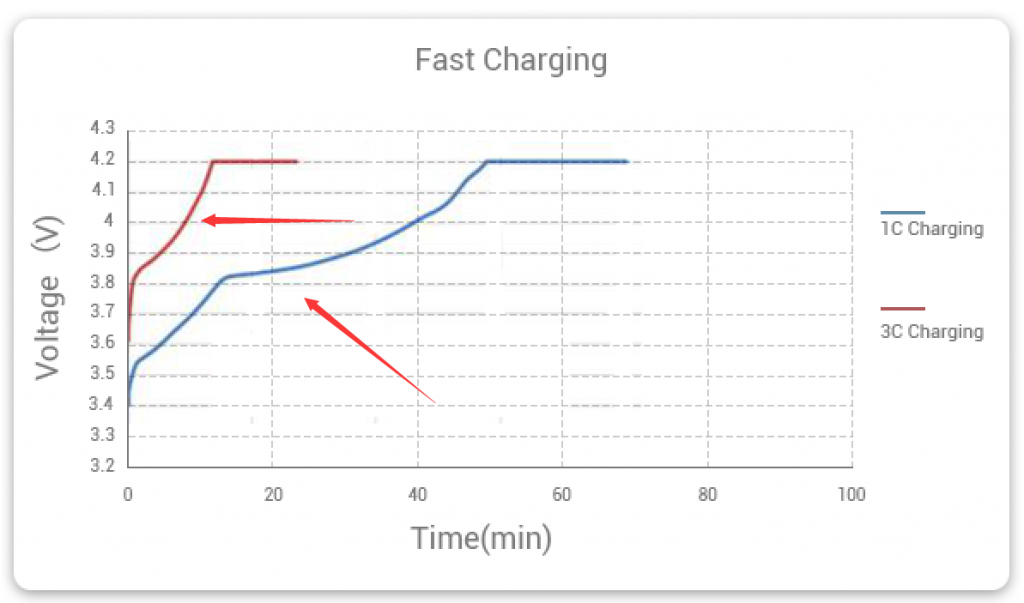
0.5C vs 0.5P: Detailed Comparison
| Aspect | 0.5C (Constant Current) | 0.5P (Constant Power) | Winner for Energy Storage? |
|---|---|---|---|
| Control Object | Fixed current (A) | Fixed power (W) | Depends on use case |
| Voltage Behavior | Stable platform | Noticeable fluctuations | 0.5C for testing |
| Capacity Retention | Higher (often >95% at low rates) | Lower (more decay at high rates) | 0.5C |
| Energy Efficiency | Generally higher | Lower due to dynamic current adjustments | 0.5C |
| Real-World Application | Lab testing, R&D, cell sorting | Grid scheduling, power station operation | 0.5P |
| Polarization Effects | Lower at moderate rates | Higher because current ramps to hold power | 0.5C |
Pro tip: At low rates like 0.5C/0.5P, the performance gap is smaller. But once you push toward 1C–2C or 1P–2P, the differences become very clear — especially in LiFePO₄ batteries commonly used in utility-scale storage.

Why These Differences Matter for Grid-Scale Energy Storage
Energy storage systems don’t operate in a vacuum. When a power station is connected to the grid, operators need predictable power output to balance supply and demand, participate in frequency regulation, or shift solar energy from daytime to evening peaks.
- 0.5P mode aligns perfectly with grid requirements because it guarantees steady kilowatt delivery — exactly what utilities and energy management systems demand.
- 0.5C mode, while excellent for characterizing cells in the factory or lab, would require constant power electronics adjustments in the field, making it impractical for large-scale ESS.
The trade-off? Slightly lower round-trip efficiency and faster capacity fade under constant-power operation. That’s why top-tier battery manufacturers and system integrators now design advanced battery management systems (BMS) that intelligently blend both modes depending on operating conditions.
Choosing the Right Mode for Your Energy Storage Project
- Lab / R&D / Quality Control → Stick with 0.5C for accurate benchmarking.
- Commercial & Utility-Scale ESS → Design around 0.5P (or variable P-rates) to match real grid demands.
- Hybrid systems (solar + storage + EV charging) → Modern inverters and PCS (power conversion systems) can switch intelligently between current- and power-based control.
Understanding these nuances helps project developers, EPC contractors, and asset owners maximize ROI, extend battery life, and meet performance guarantees in long-term power purchase agreements (PPAs).
Conclusion
As the global energy storage market surges toward terawatt-hour scale, the conversation is shifting from raw capacity (kWh) to how that capacity is delivered. 0.5C vs 0.5P is a perfect example of why “it’s not just about the cells — it’s about the system.”
Whether you’re evaluating LFP batteries for a new solar farm or optimizing an existing BESS portfolio, mastering these charge-discharge fundamentals will give you a competitive edge in 2026 and beyond.
Have questions about C-rate vs P-rate in your specific project? Drop them in the comments below!