
BYD 4680 Cylindrical Lithium Cell: Driving EV and Energy Storage Innovation
The rapid expansion of new energy vehicles (NEVs) and energy storage systems has made large-format lithium-ion batteries the focal point of the industry. While Tesla’s 4680 cylindrical battery captured headlines with its high energy density and streamlined pack design, BYD has introduced its own groundbreaking BYD 4680 cylindrical cell—a 4680 lithium cell built on an LFP (lithium iron phosphate) and graphite chemistry. This innovative 4680 cylindrical cell takes a distinct technical path that balances safety, cost-effectiveness, and high-power performance, offering fresh possibilities for the sector.
In this in-depth guide, we break down the BYD 4680 cylindrical cell through physical disassembly, advanced imaging, electrochemical testing, and material-level analysis to reveal exactly what makes this 4680 lithium cell stand out.
Exterior Design and Disassembly: Smart Engineering for Safety and Stability
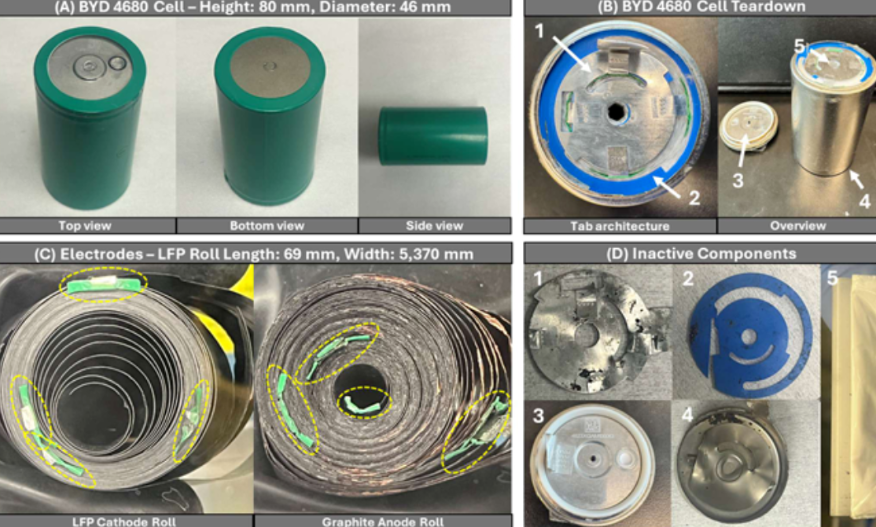
The BYD 4680 cylindrical cell adheres to the industry-standard format: 46 mm diameter and 80 mm height. Unlike some competitors that use bare nickel-plated steel cans, this 4680 lithium cell features an outer insulating sleeve for enhanced electrical isolation and protection.
Disassembly (performed safely in an argon-filled glovebox after discharging to 2.8 V) uncovers several clever internal features:
- Multi-tab architecture: The positive electrode (LFP) uses four aluminum tabs, while the negative electrode (graphite) employs three nickel tabs. One nickel tab on the jelly roll is fully covered with PET tape and not connected to the terminal. This layout optimizes current distribution and minimizes localized heating risks.
- Plastic core axis: Instead of a hollow center, the jelly roll is supported by a hexagonal polypropylene (PP) plastic mandrel. This structural element prevents deformation under high stress without storing extra electrolyte or channeling gas, delivering superior mechanical stability in a large-format 4680 cylindrical cell.
These design choices make the BYD 4680 cylindrical cell exceptionally robust and safe—key advantages for real-world applications.
3D X-Ray CT Imaging: Unmatched Consistency for Long-Lasting Performance
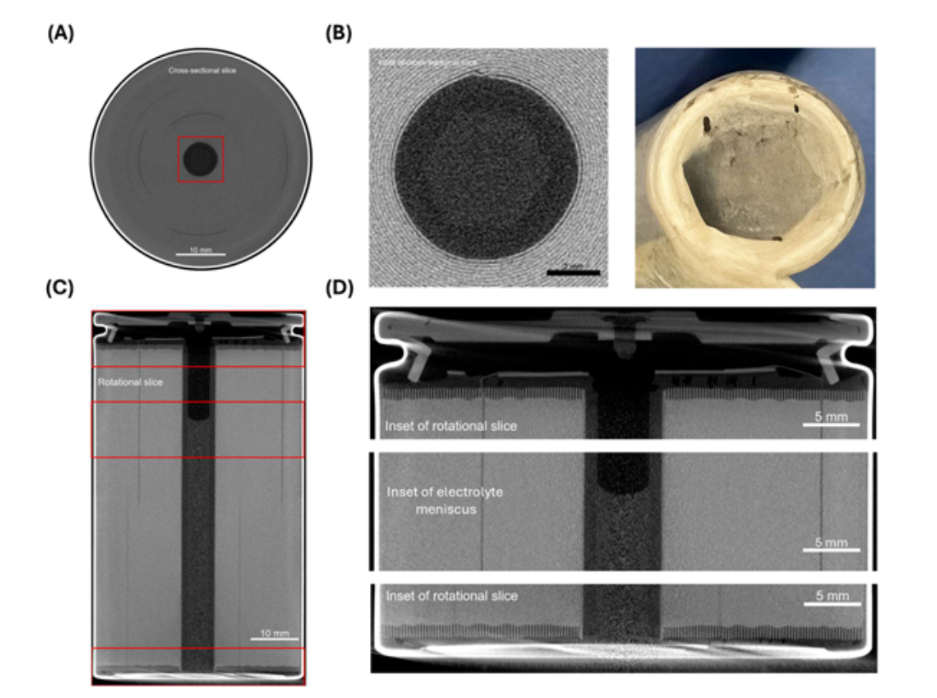
To evaluate internal quality, researchers performed non-destructive 3D X-ray CT scans on 25 units of the BYD 4680 cylindrical cell. The results highlight industry-leading uniformity:
- Core area and roundness relative standard deviation (RSD) values as low as 0.546% and 0.467%, respectively.
- Minimum roundness reaching 97.2%—significantly better than typical cylindrical cells.
Clear CT slices reveal precise tab welding positions and electrolyte meniscus details, confirming that the multi-tab design ensures even current flow. This exceptional structural consistency in the 4680 lithium cell greatly reduces the risk of jelly-roll deformation during cycling or fast charging, laying a solid foundation for extended cycle life and superior safety.
Electrochemical Performance: High-Power Breakthrough in an LFP System
As an LFP-based 4680 cylindrical cell, the BYD design strikes an excellent balance between energy density and power capability. Here’s what the testing shows:
Energy Density
At C/5 discharge rate, the cell delivers 15.41 Ah capacity with an average voltage of 3.2 V. This translates to:
- 151 Wh/kg gravimetric energy density
- 374.6 Wh/L volumetric energy density
While lower than high-nickel chemistries, these figures reflect the inherent strengths of LFP—lower cost and exceptional thermal stability—while still meeting practical needs in the 4680 lithium cell format.
Cycle Stability
After 10 cycles at C/5, capacity fade is under 0.1%, and Coulombic efficiency approaches 100%. The stable SEI formation and well-matched electrode materials promise outstanding long-term durability.
Rate Capability (The Standout Feature)
- 1C discharge retains 94.7% capacity utilization.
- 2C discharge (30 A high current) still achieves 87.9% utilization—outperforming many expectations for LFP systems.
Voltage remains stable under 2C loads, making this BYD 4680 cylindrical cell ideal for fast-charging and high-power scenarios. The secret lies in the thin negative electrode coating, multi-tab layout, and titanium-doped LFP chemistry, all of which accelerate lithium-ion transport.
Impedance Characteristics
Charge-transfer resistance at 20% SOC is just 5.9 Ω·cm². HPPC testing confirms DC resistance behavior typical of LFP cells, with discharge resistance rising more noticeably at lower SOC states.
Material Analysis: Nano-Scale Innovations Powering High-Rate Performance
Scanning electron microscopy (SEM) and energy-dispersive X-ray spectroscopy (EDS) provide a microscopic view of why the 4680 lithium cell performs so well:
Positive Electrode (LFP)
- 100–300 nm spherical nano-LFP particles paired with micron-sized conductive carbon shorten lithium diffusion paths.
- Approximately 0.3 at% titanium doping reduces lattice spacing, boosting ion mobility—the key enabler of the cell’s impressive rate capability.
- EDS confirms near-ideal 1:1:4 stoichiometry for maximum electrochemical activity and stability.
Negative Electrode (Graphite)
- Flake graphite particles (max 10 μm diameter) with no silicon additives.
- Ultra-thin 54.5 μm coating—54% thinner than comparable designs—lowers ohmic resistance and speeds up lithium diffusion.
- Traditional slurry coating process with carboxymethyl cellulose (CMC) binder detected via sodium traces, ensuring mechanical integrity.
These material choices keep manufacturing mature and cost-effective while delivering high-rate performance in the BYD 4680 cylindrical cell.
Why the BYD 4680 Cylindrical Cell Matters: A New Path for the Industry
The BYD 4680 cylindrical cell charts a different course from Tesla’s tabless, high-nickel 4680 design. By combining a multi-tab structure with proven LFP chemistry, plus smart mechanical supports and optimized electrode coatings, BYD has created a 4680 lithium cell that excels in cost, safety, and fast-charging performance.
This 4680 cylindrical cell is particularly well-suited for ride-hailing fleets, energy storage stations, and any application where reliability, affordability, and rapid charging are priorities. Its ultra-high structural uniformity also sets a new benchmark, proving that large-format cylindrical batteries can achieve exceptional consistency through intelligent design and precise manufacturing.
Looking ahead, further improvements in LFP energy density—paired with the pack-level advantages of 4680-format cells—could position the BYD 4680 cylindrical cell as a high-value solution across the global NEV and energy storage markets.
Ready to explore the future of battery technology? The BYD 4680 cylindrical cell and its 4680 lithium cell platform demonstrate that innovation doesn’t always mean chasing the highest energy density—it’s about delivering the right balance of performance, safety, and economics for real-world demands.